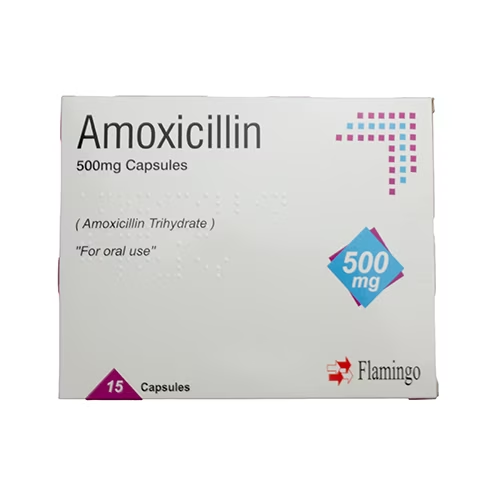
Amoxicillin trihydrate is a semisynthetic broad-spectrum aminopenicillin antibiotic in the β-lactam class. The substance commonly used in oral medicines is the trihydrate crystal form rather than free anhydrous amoxicillin. The IUPAC name is (2S,5R,6R)-6-[[(2R)-2-amino-2-(4-hydroxyphenyl)acetyl]amino]-3,3-dimethyl-7-oxo-4-thia-1-azabicyclo[3.2.0]heptane-2-carboxylic acid trihydrate. For readers asking what is amoxicillin trihydrate, it is the hydrated drug substance form that supplies amoxicillin in many oral products. The molecular formula of anhydrous amoxicillin is C₁₆H₁₉N₃O₅S, with an amoxicillin trihydrate molecular weight of 419.4 g/mol for C₁₆H₁₉N₃O₅S·3H₂O and 365.40 g/mol for the anhydrous substance.
Identity
Pharmacopoeias and drug references list both amoxicillin trihydrate and related pharmaceutical forms. Amoxicillin is described as a white to almost white powder or crystalline solid, sometimes with a slight pinkish cast. Reported melting behavior is around 194 °C, with a value of 190.1 °C reported under helium. Anhydrous amoxicillin has a specific optical rotation of +290 to +315.
The amoxicillin trihydrate structure is that of the amoxicillin molecule with three waters of crystallization. During crystallization from solution, amoxicillin commonly incorporates three water molecules into the crystal lattice. Anhydrous amoxicillin can also be prepared and used, but the trihydrate is the usual oral drug substance.
Properties
In its trihydrate form, amoxicillin trihydrate solubility is limited in water. It is slightly soluble in water, very slightly soluble in ethanol, and practically insoluble in fatty oils. It is also very slightly soluble in ether. Amoxicillin dissolves in dilute acids and in dilute alkali hydroxide solutions. This behavior reflects its amphoteric character.
The molecule contains multiple ionizable groups. Reported pKₐ values are approximately 2.4, 7.4, and 9.6 in water, with closely related values reported at 37 °C. Because of this, amoxicillin changes ionic form across physiologic pH. In acidic gastric conditions it is more protonated. In the upper small intestine it is mainly zwitterionic. At more alkaline intestinal pH, deprotonated forms become more important.
A practical point for handling is pH-dependent stability. Amoxicillin in dilute aqueous solution shows minimum degradation near pH 6.0. Acidic and alkaline conditions increase breakdown. Phosphate and citrate buffers can catalyze degradation, and this matters in formulation and analytical work.
Hydrate significance
The hydrate form is not just a naming detail. Amoxicillin trihydrate is the pharmaceutical form selected for many oral solids because the crystal form affects storage behavior, processing, and labeling.
Hydrated forms including monohydrate, dihydrate, and trihydrate have been described. Among these, the trihydrate is reported as the most stable hydrate. Work on β-lactam solid-state reactivity has shown that amoxicillin trihydrate is more stable than anhydrous amoxicillin under high temperature and high humidity conditions, while the anhydrous form is more stable under dry storage. That distinction is directly relevant to manufacturing and packaging. Oral products are exposed to ambient moisture during granulation, compression, coating, filling, transport, and patient use. A hydrate form with better humidity tolerance is often more practical.
The crystal form also affects product naming and strength expression. A tablet labeled as containing a given amount of amoxicillin trihydrate is supplying a defined amount of that hydrate material, not an interchangeable mass of another form. In finished medicines, dose calculations and specifications are tied to the selected pharmaceutical form.
Forms
A useful comparison is between amoxicillin trihydrate, anhydrous amoxicillin, and amoxicillin sodium.
| Form | Main use | Water behavior | Typical context |
|---|---|---|---|
| Amoxicillin trihydrate | Oral solids and many oral suspensions | Slightly soluble | Capsules, tablets, chewables, powders for suspension |
| Anhydrous amoxicillin | Alternative drug substance form | Used less commonly in routine oral products | Manufacturing or specific formulations |
| Amoxicillin sodium | Parenteral use | Freely reconstituted for injection use | Powder for injection, intravenous or intramuscular administration |
Amoxicillin trihydrate vs amoxicillin sodium is mainly a formulation question. The trihydrate is the common oral amoxicillin formulation because amoxicillin is acid-stable enough for oral delivery and the trihydrate crystal form is suitable for solid dosage forms. Amoxicillin sodium is used for injection, where rapid dissolution and parenteral administration are needed.
Amoxicillin anhydrous vs trihydrate is more of a solid-state and manufacturing distinction. Both represent the same active antibiotic moiety, but the crystal water changes mass, handling, and storage behavior.
Mechanism
The amoxicillin trihydrate mechanism of action is the same as amoxicillin. Amoxicillin is bactericidal. It binds penicillin-binding proteins in the bacterial cell wall synthesis pathway and blocks peptidoglycan cross-linking. The original source material identifies binding to penicillin-binding protein 1A as a core anchor point. More generally, inhibition of PBPs prevents proper cell wall assembly, weakens the wall, and leads to osmotic failure and lysis.
As a β-lactam antibiotic, amoxicillin acts only on susceptible bacteria. Amoxicillin by itself is active against many gram-positive and some gram-negative organisms, but it is vulnerable to β-lactamase enzymes. Beta-lactamase resistance is a major limit of amoxicillin monotherapy. Bacteria that produce these enzymes can hydrolyze the β-lactam ring and inactivate the drug.
That is why amoxicillin is often paired with clavulanate in practice. Clavulanate is a β-lactamase inhibitor that protects amoxicillin against many β-lactamase-producing organisms, expanding activity where amoxicillin alone would be unreliable. This does not remove all resistance problems, since altered PBPs and other mechanisms can still reduce susceptibility.
Activity limits
Amoxicillin should be understood as an antibiotic for susceptible infections, not as a universal treatment for infections at a given body site. Statements about use depend on the likely organism, local resistance patterns, severity, and clinical guidance.
Amoxicillin alone is mainly appropriate when the pathogen is susceptible and β-lactamase production is not expected to defeat therapy. This is why culture results, susceptibility testing, and epidemiology remain important. In routine practice, a clinical need for β-lactamase coverage often shifts treatment toward amoxicillin/clavulanate rather than amoxicillin alone.
Uses
Amoxicillin trihydrate uses in medicine center on oral treatment of susceptible bacterial infections. Common clinical use includes selected ear, throat, nasal, skin, urinary tract, and respiratory infections. The original article also noted use in research on antibiotic resistance because amoxicillin is so widely used.
Additional uses described in recognized drug references include oral infections, some skin and soft tissue infections, and use as part of Helicobacter pylori eradication regimens. Broader prescribing contexts exist, but the key point is unchanged: amoxicillin is chosen for susceptible organisms, not simply for an anatomic location.
Because this article focuses on the substance and its pharmaceutical forms, it does not provide dosing instructions. Actual dose selection depends on indication, formulation, age, body size, renal function, severity, and current treatment guidance.
Oral delivery
A major reason oral amoxicillin formulation is so common is gastric acid stability. Amoxicillin remains stable enough in gastric conditions to permit effective oral administration. This makes capsules, tablets, chewable tablets, dispersible tablets, and suspensions practical dosage forms.
Oral absorption is generally good, though amoxicillin shows dose-dependent absorption behavior at higher doses. The compound is absorbed from the small intestine rather than the colon. Reported studies support high absorption at common lower doses, while higher doses can show reduced fraction absorbed, likely due to a combination of solubility limits and saturable carrier-mediated transport.
Dosage forms
Amoxicillin trihydrate dosage forms listed in pharmacopoeial and essential-medicines contexts include:
- Capsules: 250 mg and 500 mg
- Tablets: 200-1000 mg
- Chewable tablets: 125-500 mg
- Dispersible tablets: 750 mg
- Oral suspension and dry powder for oral suspension
- Larger oral presentations including 3 g products
- Powder for injection in the sodium form for parenteral use
WHO essential medicines listings include common oral solid forms containing 250 mg and 500 mg amoxicillin as trihydrate, and current WHO electronic listing also identifies oral liquids as trihydrate and injections as sodium. In most everyday indications, the 250 mg and 500 mg oral strengths are the most familiar.
Different oral forms exist for practical reasons. Capsules and standard tablets suit routine adult use. Chewable and dispersible forms help when swallowing intact solids is difficult. Powders for oral suspension are used where liquid dosing is needed, especially in children. Dispersible tablets also offer storage and transport advantages over bottled liquid products and are less dependent on bulky packaging.
Pharmaceutical handling
Amoxicillin trihydrate is moisture-sensitive enough that dosage form design and packaging matter. Work on dispersible tablets has emphasized that water-sensitive products are better protected in blisters than in repeatedly opened multidose containers. For liquid products supplied as dry powders, reconstitution supports better shelf stability before dispensing.
The drug substance is also stability-sensitive in solution, so manufacturing methods for moisture-exposed forms must be chosen carefully. For example, dry processing approaches are often preferred over wet processing when the formulation is highly sensitive to moisture and heat.
Clinical boundaries
Amoxicillin remains widely used and globally important, but its usefulness is bounded by susceptibility. Broad statements about strengths or formulations should not be read as dosing advice. A 250 mg capsule, a 500 mg tablet, a chewable tablet, and a suspension all serve different product and patient needs even when they deliver the same antibiotic.
For the same reason, the presence of amoxicillin trihydrate on pharmacopoeial lists and essential-medicines lists signals importance and widespread utility, not interchangeability of all products across all uses. Form, strength, and microbial susceptibility still govern appropriate application.
References
Thambavita D, Galappatthy P, Mannapperuma U, Jayakody L, Cristofoletti R, Abrahamsson B, Groot DW, Langguth P, Mehta M, Parr A, Polli JE, Shah VP, Dressman J. Biowaiver Monograph for Immediate-Release Solid Oral Dosage Forms: Amoxicillin Trihydrate. J Pharm Sci. 2017;106(10):2930-2945. URL
World Health Organization. Amoxicillin - eEML - Electronic Essential Medicines List. URL
Wockhardt UK Ltd. Amoxicillin Sodium for Injection - Summary of Product Characteristics (SmPC). URL
Akhavan BJ, Khanna NR, Vijhani P. Amoxicillin. StatPearls. URL