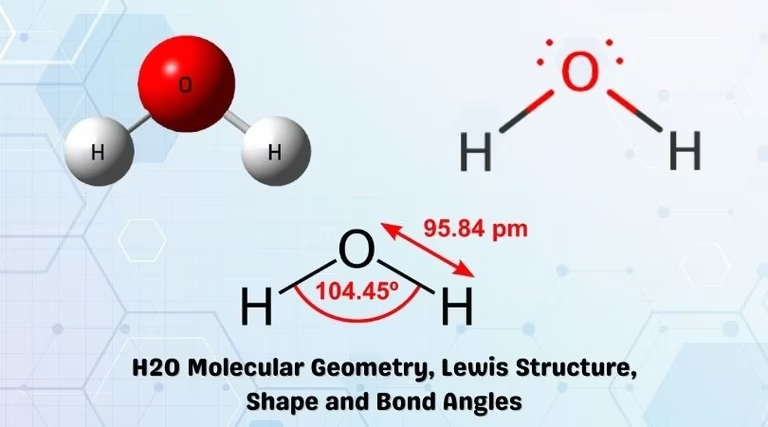
Water is H₂O, a small covalent molecule made of two hydrogen atoms bonded to one oxygen atom. The H₂O Lewis structure shows two O-H single bonds and two lone pairs on oxygen. From that arrangement, the electron geometry of H₂O is tetrahedral, the molecular geometry of H₂O is bent, the bond angle of H₂O is about 104.5°, and the molecule is polar.
Bonding
Inside one water molecule, each hydrogen is connected to oxygen by a polar covalent bond. These are ordinary intramolecular O-H bonds formed by sharing electrons.
Hydrogen bonding is different. Hydrogen bonds occur between separate water molecules, not inside a single H₂O molecule. This distinction matters because the lewis structure of H₂O describes the covalent bonding within one molecule, while hydrogen bonding helps explain bulk properties such as water's high boiling point, cohesion, and strong intermolecular attraction.
Valence electrons
The first step in drawing the lewis structure for H₂O is to count the H₂O valence electrons.
- Oxygen contributes 6 valence electrons.
- Each hydrogen contributes 1 valence electron.
- Total valence electrons in H₂O = 8.
So, if the question is how many valence electrons does H₂O have, the answer is 8 total valence electrons.
Lewis structure
A correct water lewis structure can be built in a short sequence.
Step 1
Place oxygen in the center. Hydrogen usually forms one bond and does not serve as the central atom in this molecule.
Step 2
Connect each hydrogen to oxygen with a single bond. Two single bonds are formed, giving H-O-H.
At this stage, 4 of the 8 total valence electrons have been used. Each single bond contains 2 electrons, so the two O-H bonds account for 4 bonding electrons total.
Step 3
Place the remaining 4 electrons on oxygen as two lone pairs. Oxygen now has two bonding pairs and two lone pairs around it.
Step 4
Check electron requirements. Each hydrogen has 2 electrons through its bond, which satisfies the duet rule. Oxygen has 8 electrons around it when the two bonding pairs and two lone pairs are counted, so oxygen satisfies the octet rule.
That is the lewis structure of water. In electron bookkeeping terms, H₂O has 8 total valence electrons, 4 electrons in bonding pairs, and 4 electrons as lone-pair electrons on oxygen.
Formal charge
The lewis dot structure of H₂O also gives zero formal charge on all atoms.
For oxygen: Formal charge = 6 - 4 nonbonding electrons - 2 bonding pairs counted as 1 each = 0
For each hydrogen: Formal charge = 1 - 0 - 1 = 0
This confirms that the usual electron dot structure of water is the preferred structure.
Electron geometry
Under VSEPR theory, the structure of water molecule is analyzed by counting electron domains around the central oxygen atom. Oxygen has four electron domains in total:
- two bonding domains from the two O-H bonds
- two lone-pair domains
Four electron domains correspond to a tetrahedral electron arrangement. For this reason, the electron geometry of H₂O, also called the electron pair geometry of H₂O, is tetrahedral.
The steric number of H₂O is 4 because oxygen is surrounded by four regions of electron density.
Molecular geometry
When only atom positions are considered, the molecular geometry of water is different from its electron geometry. Because two of the four electron domains are lone pairs, only the two hydrogen atoms are visible in the molecular shape.
As a result, the molecular geometry of H₂O is bent, also called V-shaped or angular. So, if the question is what shape is H₂O, the answer is bent.
This is a common point of confusion. The electron geometry of H₂O is tetrahedral, but the H₂O molecular geometry is bent.
Bond angle
The ideal bond angle in a tetrahedral electron arrangement is 109.5°. Water does not keep that ideal angle.
In H₂O, the two lone pairs on oxygen repel more strongly than bonding pairs repel each other. Lone pair-bond pair and lone pair-lone pair repulsions push the O-H bonds closer together. Because of that compression, the H-O-H angle decreases from 109.5° to about 104.5°.
The bond angle of H₂O is therefore 104.5°. This value is often written as the H₂O bond angle or the water molecule bond angle.
Hybridization
In the common introductory bonding model, oxygen in water is described as sp³ hybridized. One 2s orbital and three 2p orbitals combine to give four sp³ hybrid orbitals.
This picture matches the four electron domains around oxygen. Two sp³ hybrid orbitals are used for the two O-H bonding interactions, and two contain the lone pairs. In that sense, the hybridization statement is connected directly to the lewis structure of H₂O and the tetrahedral electron geometry.
Polarity
Water is polar. Two factors produce that polarity.
First, each O-H bond is polar because oxygen is more electronegative than hydrogen. Electron density is pulled closer to oxygen, giving oxygen a partial negative charge and the hydrogens partial positive charges.
Second, the bent geometry prevents the bond dipoles from canceling. In a linear arrangement, equal bond dipoles could oppose one another and sum to zero. In water, the V-shaped structure causes the bond dipoles to add to a net dipole moment.
That is why the water molecule structure is polar rather than nonpolar.
Why polarity matters
Because water is polar, water interacts strongly with ions and many polar molecules. This is a major reason water is such an effective solvent for salts and many other substances.
The same polarity also supports strong hydrogen bonding between water molecules. Those intermolecular attractions contribute to several familiar bulk properties, including a relatively high boiling point for such a small molecule, strong cohesion, and high surface tension.
Comparisons
A short comparison helps the geometry make sense.
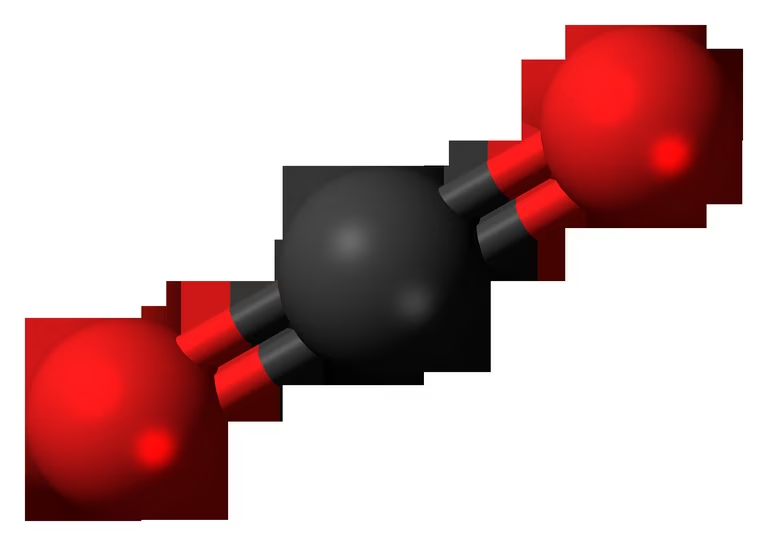
CO₂ is linear because the central carbon has two electron domains and no lone pairs. Its bond dipoles cancel, so CO₂ is nonpolar.
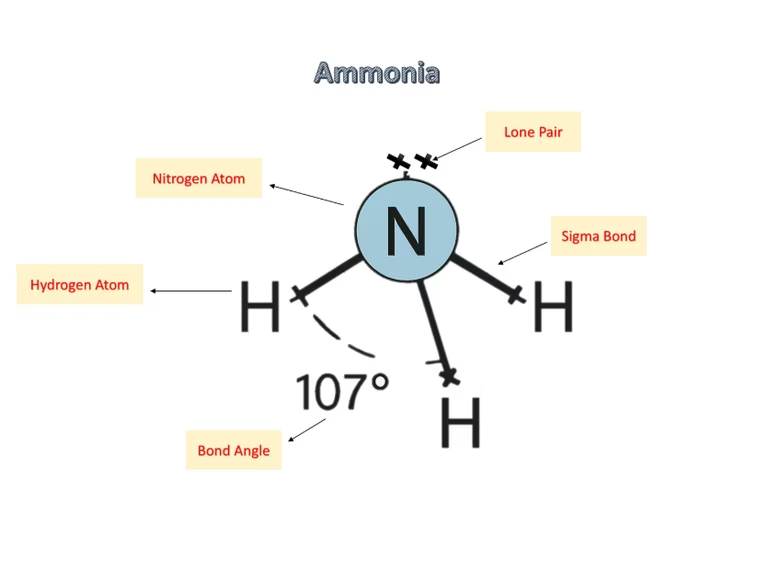
NH₃ has four electron domains around nitrogen, like water, but only one of those domains is a lone pair. Its molecular shape is trigonal pyramidal. Water has two lone pairs on the central atom, so its shape is bent and its bond angle is smaller than the bond angle in NH₃.
H₂S is also bent, but its bonding and polarity behavior differ from water because sulfur is less electronegative than oxygen and hydrogen bonding is much weaker.
Misconceptions
Water is not linear. The two lone pairs on oxygen make the molecular geometry bent.
Water is not held together by ionic bonds. The O-H bonds in a water molecule are polar covalent bonds.
Water is not nonpolar. The bent shape and polar O-H bonds give water a net dipole moment.
Hydrogen bonds are not the same as the covalent bonds shown in the h2o lewis structure. The Lewis structure of water shows bonding within one molecule. Hydrogen bonding happens between molecules.
Quick facts
| Property | H₂O |
|---|---|
| Total valence electrons | 8 |
| Central atom | O |
| O-H bonds | 2 single bonds |
| Lone pairs on oxygen | 2 |
| Bonding electrons | 4 |
| Lone-pair electrons | 4 |
| Steric number | 4 |
| Electron geometry | Tetrahedral |
| Molecular geometry | Bent / V-shaped |
| Bond angle | 104.5° |
| Hybridization model | sp³ |
| Polarity | Polar |