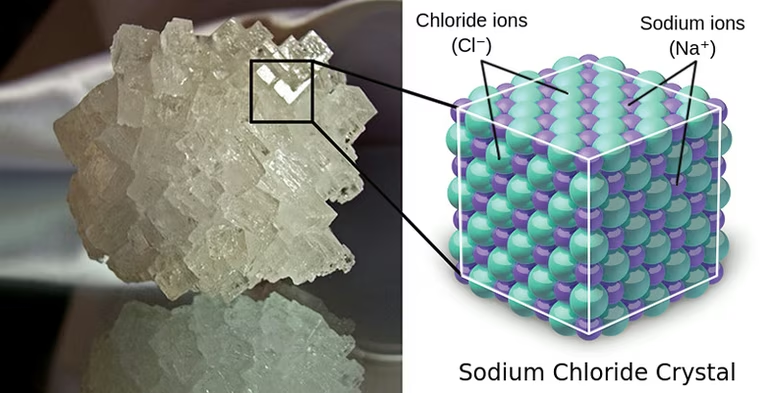
Sodium chloride is the ionic compound NaCl, the substance commonly called salt. In pure form, sodium chloride consists of sodium ions (Na⁺) and chloride ions (Cl⁻) arranged in a repeating crystal lattice. Sodium chloride is one of the most abundant minerals on Earth, is widely present in seawater and natural deposits, and is an essential electrolyte in living systems. Sodium chloride is the main salt in seawater and in the extracellular fluid of many multicellular organisms, including humans.
Identity
What is sodium chloride at the chemical level? Sodium chloride forms when sodium, which readily loses one electron, and chlorine, which readily gains one electron, produce oppositely charged ions that attract each other. That electrostatic attraction is what makes sodium chloride an ionic compound. The chemical formula for sodium chloride is NaCl because the crystal contains sodium and chloride in a 1:1 ratio.
In the solid state, sodium chloride does not exist as separate NaCl molecules in the way water exists as H₂O molecules. Instead, sodium chloride forms a three-dimensional ionic crystal. Each ion is surrounded by ions of the opposite charge in a regular arrangement. This mineral form of sodium chloride is halite, also called rock salt.
When sodium chloride is placed in water, the polar water molecules stabilize Na⁺ and Cl⁻, so sodium chloride dissolves readily and forms a saline solution. This behavior helps explain why sodium chloride is useful in physiology, medicine, food processing, and industrial chemistry.
Salt types
Is sodium chloride salt? For practical purposes, yes: common salt is mainly sodium chloride. But the familiar terms are not always exactly interchangeable.
Pure sodium chloride is the defined chemical substance NaCl. Table salt is usually sodium chloride prepared for household use and may contain additives such as anti-caking agents, and in many countries it is iodized. Sea salt is obtained by evaporating seawater and is still largely sodium chloride, but it can contain small amounts of other minerals. Laboratory sodium chloride refers to a controlled-grade material used for analytical, medical, or industrial purposes.
Medical saline is something different again. Saline solution is water containing a measured concentration of sodium chloride. In medicine, the concentration matters more than the name.
Biological role
Sodium chloride is an essential nutrient because sodium and chloride are major electrolytes. Sodium chloride helps maintain plasma volume, extracellular fluid balance, acid-base balance, nerve impulse transmission, and normal cell function. In the body, sodium chloride is closely tied to osmotic balance, meaning the control of water movement between compartments.
Sodium chloride is the major salt that maintains osmotic tension in blood and tissues. The original article notes that it accounts for more than 90 per cent of the inorganic component of blood serum. Sodium chloride is also the dominant salt in extracellular fluid, which is why shifts in sodium balance can quickly affect hydration status, circulation, and neurological function.
Too little sodium chloride and too much sodium chloride can both be dangerous. That is the key physiological point. The body needs sodium chloride, but within a controlled range.
Medical use
Sodium chloride in medicine is usually given as a solution, not as dry salt. A 0.9% sodium chloride solution is often called normal saline or isotonic saline because it is close to the salt concentration of blood and extracellular fluid. It is widely used for fluid replacement, dilution of injectable medicines, and certain irrigation uses.
Sodium chloride is used in healthcare to help prevent dehydration in patients. Sodium chloride solutions are also used to clean wounds, to moisten nasal passages, and to relieve nasal congestion. Eye preparations containing sodium chloride may be used to irrigate the eye or to help manage red, watery, or dry eyes, depending on the formulation.
More concentrated sodium chloride solutions are called hypertonic saline. Hypertonic saline has medical uses because it draws water across osmotic gradients. That principle is also why concentration must be chosen carefully. Isotonic saline is suitable for many routine uses, while hypertonic saline is reserved for specific indications under medical supervision.
An outdated and unsafe historical use of sodium chloride was as an emetic. Salt solutions have caused deaths when used to induce vomiting. Sodium chloride should not be used for that purpose.
Food use
Sodium chloride in food has two main roles: flavor and preservation. Common salt is used to enhance taste and to help control spoilage. Sodium chloride lowers water activity in foods and can slow the growth of many microorganisms, which is why it has long been used in curing, pickling, and general preservation.
In everyday diets, sodium chloride intake often comes less from the salt shaker than from processed and restaurant foods. Current public health guidance reflects that pattern. The World Health Organization recommends that adults consume less than 2 g sodium per day, equivalent to less than 5 g salt per day. The U.S. CDC reports that average sodium intake in Americans is more than 3,300 mg per day and that most sodium comes from processed and restaurant foods rather than salt added at the table.
Industrial use
Sodium chloride industrial uses extend well beyond food. Sodium chloride is a major raw material for heavy chemical manufacture. Through the chlor-alkali process, brine is electrolyzed to produce chlorine, sodium hydroxide, and hydrogen. These products are basic feedstocks for many industries.
Chlorine derived from sodium chloride is used in water disinfection, bleaching chemistry, and the production of many chlorinated intermediates. Sodium hydroxide from the same process is used in paper manufacture, soap and detergent production, petroleum processing, and many neutralization and cleaning operations. Chlorine chemistry is also tied to the production of hydrochloric acid and to vinyl chloride and polyvinyl chloride (PVC), which is why sodium chloride indirectly supports plastics manufacture.
Outside bulk chemistry, sodium chloride is used for water conditioning and water treatment, and large quantities are used to de-ice roads and pavements. Sodium chloride lowers the freezing point of water, which is the reason it is effective in de-icing applications.
Cosmetics are another use area. Sodium chloride can be included in cosmetic and personal care formulations for viscosity control and related formulation functions.
The original source also mentioned flame retardant use. That is a specialized and limited application, but it has been reported among the many technical uses associated with sodium chloride.
Safety
Sodium chloride side effects depend on dose, route, and context. In normal dietary amounts, sodium chloride is necessary. At very high intake or under conditions that impair water balance, sodium chloride can become toxic.
Ingestion of large amounts of salt in a short period can be fatal. The original article gave an acute estimate of about 1 g per kilogram of body weight as potentially lethal. Deaths have been reported after forced salt intake, accidental substitution of salt for sugar in children's food, and attempts to use salt water to induce vomiting.
Too little sodium can also be life-threatening. Too little sodium symptoms can include muscle cramps, dizziness, and electrolyte disturbances. When sodium levels fall enough to disturb brain function, neurological symptoms, seizures, coma, and death can occur.
Blood pressure
Salt and blood pressure are linked through fluid balance. A diet high in sodium chloride disrupts the body's sodium balance and promotes fluid retention. More retained fluid increases the pressure exerted by blood against vessel walls, which can contribute to hypertension.
Chronic or prolonged excessive salt intake has been associated with high blood pressure, stroke, left ventricular hypertrophy, and stomach cancer. The hypertension link is especially well established. Kotchen discussed the contribution of sodium and chloride to NaCl-induced hypertension, emphasizing that sodium chloride itself is relevant to blood pressure biology rather than sodium alone in all contexts.
The original article included an estimate that reducing salt intake from 10 g to 6 g per day could lower blood pressure enough to reduce deaths from stroke by 16 per cent and deaths from coronary heart disease by 12 per cent. That remains a useful illustration of why sodium reduction is treated as a population health measure.
WHO reports that the global mean adult sodium intake is about 4,310 mg/day, equivalent to about 10.78 g/day salt, which is more than double the WHO recommendation. This provides practical context for the earlier 10 g to 6 g comparison: many populations are still consuming sodium chloride at levels high enough to sustain avoidable cardiovascular risk.
Intake context
A few simple conversions help orient sodium chloride intake:
| Measure | Approximate equivalent |
|---|---|
| 1 g salt | 400 mg sodium |
| 5 g salt | 2,000 mg sodium |
| 1 teaspoon table salt | about 2,400 mg sodium |
These figures matter because many people think only in terms of "salt," while nutrition labels often list "sodium." Sodium chloride is about 40% sodium and 60% chloride by weight.
Processed foods are a major source of excess intake. CDC identifies major contributors such as sandwiches, pizza, soups, chips and crackers, cold cuts and cured meats, breads and tortillas, and mixed grain or meat dishes. That pattern helps explain why sodium chloride intake can become excessive even without visibly salty meals.
Misconceptions
Sea salt is not low-sodium salt. Sea salt is still mainly sodium chloride.
More electrolytes are not always better. Sodium chloride is essential, but extra sodium chloride beyond physiological need can worsen fluid overload and blood pressure.
Salt water is not a safe home emetic. That practice is dangerous and has caused deaths.
Saline is not the same thing as any salt water mixture. Medical saline products have defined sodium chloride concentrations and are used for specific purposes.
References
Kotchen TA. Contributions of sodium and chloride to NaCl-induced hypertension. Hypertension. 2005;45(5):849-850. URL
World Health Organization. Sodium reduction. URL
Centers for Disease Control and Prevention. About Sodium and Health. URL
Encyclopaedia Britannica. Halite. URL
Encyclopaedia Britannica. Crystal - Structure, Lattice, Symmetry. URL
Encyclopaedia Britannica. Chlorine - Production, Uses, Safety. URL