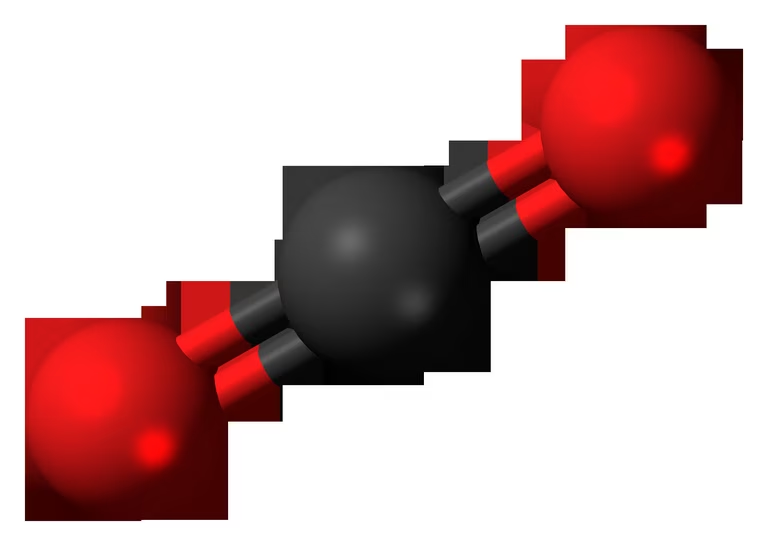
The CO₂ Lewis structure shows how the valence electrons are arranged in carbon dioxide. In the lewis structure of CO2, carbon is the central atom, each oxygen is attached to carbon, the final structure contains two C=O double bonds, each oxygen has two lone pairs, and carbon has no lone pairs. This electron dot structure of CO2 is used to explain bonding, formal charges, molecular shape, and why carbon dioxide is nonpolar overall.
Lewis structure basics
A Lewis structure is a 2D representation of valence electrons in a molecule. It shows which atoms are connected, which electrons are shared in covalent bonds, and which electrons remain as lone pairs. The Lewis structure does not directly show the full 3D shape of a molecule, but it provides the electron arrangement needed to predict that shape.
For carbon dioxide, the structural formula is written as CO₂, and the carbon dioxide Lewis structure is written as O=C=O. That notation means carbon forms a double bond to each oxygen atom.
CO₂ valence electrons
The first step in drawing the lewis structure for CO2 is counting the total number of valence electrons.
Carbon contributes 4 valence electrons. Each oxygen contributes 6 valence electrons, and there are two oxygen atoms.
Total CO₂ valence electrons:
- Carbon: 4
- Oxygen: 6 × 2 = 12
- Total: 16
So the electron dot structure of carbon dioxide must account for 16 valence electrons in total.
Drawing steps
To draw the Lewis dot structure of CO2, it helps to follow a fixed sequence.
1. Choose the central atom
Carbon is placed in the center. Oxygen is usually terminal in this molecule because carbon can form multiple bonds and can connect the two oxygen atoms into one continuous structure.
The starting skeleton is:
O-C-O
2. Add single bonds
A single bond is placed between carbon and each oxygen. Each single bond contains 2 electrons, so two single bonds use 4 of the 16 valence electrons.
Electrons remaining: 12
3. Complete the octets on oxygen
The remaining 12 electrons are placed around the two oxygen atoms as lone pairs. This gives each oxygen three lone pairs in the single-bond drawing.
At this stage, carbon has only 4 electrons around it from the two single bonds, so carbon does not yet have an octet.
4. Form multiple bonds
To give carbon 8 electrons, one lone pair from each oxygen is converted into a bonding pair. This creates a double bond between carbon and each oxygen.
The final carbon dioxide structure is:
O=C=O
In this final CO₂ structure, carbon has 8 electrons around it, and each oxygen also has 8 electrons around it.
Why CO₂ has double bonds
A common question is whether CO₂ could be drawn with only single bonds. That drawing does not give the best Lewis structure.
If carbon dioxide is drawn as O-C-O with only single bonds, each oxygen can have a complete octet, but carbon is left with only 4 electrons around it. Carbon in ordinary main-group compounds usually follows the octet rule, so this is already a problem.
Formal charges also show why the single-bond version is less favorable. In the single-bond-only structure, carbon has a formal charge of +2 and each oxygen has a formal charge of -1. That produces charge separation.
When one lone pair from each oxygen is converted into a second bond, the structure becomes O=C=O. In this arrangement, the formal charge on carbon is 0 and the formal charge on each oxygen is 0. This is the preferred Lewis structure because it satisfies octets and minimizes formal charges.
That is why the correct lewis structure for CO2 contains two double bonds rather than two single bonds.
Final Lewis structure
The final carbon dioxide Lewis structure has these features:
- Carbon is the central atom
- Two oxygen atoms are terminal
- There are two C=O double bonds
- Each oxygen has two lone pairs
- Carbon has no lone pairs
- All atoms satisfy the octet rule
- Formal charges are zero on all atoms
This is the standard electron dot structure of carbon dioxide used in general chemistry.
Electron geometry
The CO₂ Lewis structure molecular geometry is understood by counting electron domains around the central atom.
Around carbon, there are two regions of electron density:
- one C=O double bond
- one C=O double bond
A double bond counts as one electron domain in VSEPR theory. Carbon therefore has two bonding domains and no lone pairs.
With two electron domains, the electron geometry around carbon is linear.
Molecular shape
The molecular shape of CO2 is also linear. Since carbon has two bonding regions and no lone pairs, the atoms arrange themselves as far apart as possible on opposite sides of the central atom.
So the carbon dioxide structure is:
O=C=O in a straight line
This gives a CO₂ bond angle of 180°. The bond angle of carbon dioxide is therefore 180°, and the carbon dioxide bond angle is one of the standard examples of a linear molecule in introductory chemistry.
Bonding and hybridization
Each C=O double bond contains one σ bond and one π bond. Carbon therefore forms two σ bonds and participates in two π bonds in CO₂.
At a slightly more advanced level, the carbon in CO₂ is described as sp hybridized. Two sp hybrid orbitals on carbon are oriented 180° apart and form the two σ bonds to oxygen. The two remaining unhybridized p orbitals on carbon participate in π bonding with oxygen.
This sp description matches the linear CO₂ molecular geometry.
Polarity
Each C=O bond is polar because oxygen is more electronegative than carbon. That means each bond has a dipole pointing toward oxygen.
The molecule as a whole is different from the individual bonds. In carbon dioxide, the two polar C=O bonds are equal in magnitude and point in opposite directions along a straight line. Because the CO₂ shape is linear and symmetric, the bond dipoles cancel.
As a result, carbon dioxide is a nonpolar molecule even though each C=O bond is polar.
This point often causes confusion. Bond polarity and molecular polarity are not the same thing. CO₂ has polar bonds but no net molecular dipole.
Lewis structure compared with other representations
The Lewis structure of CO2 shows valence electrons, lone pairs, and bonding connections. It is not the same as every other way of representing carbon dioxide.
A structural formula such as O=C=O mainly emphasizes connectivity and bond type. A Lewis structure adds lone pairs. Molecular geometry describes the 3D arrangement of atoms. Electron geometry describes the arrangement of electron domains around the central atom. These ideas are related, but they are not identical.
For CO₂, the Lewis structure leads to a linear electron arrangement around carbon, and that leads to a linear molecular shape.
Common mistakes
Several errors appear often when students draw the lewis structure for CO2.
Wrong electron count
CO₂ has 16 valence electrons, not 12 or 18. The correct total comes from 4 electrons from carbon and 12 from the two oxygen atoms.
Lone pairs on carbon
In the final carbon dioxide Lewis structure, carbon has no lone pairs. All 4 of carbon's valence electrons are involved in bonding.
Single bonds only
Drawing O-C-O with single bonds only is not the best Lewis structure. It leaves carbon without a full octet and creates unfavorable formal charges.
Treating double bonds as two domains
In VSEPR counting, each double bond is one electron domain. Carbon in CO₂ therefore has two domains, not four.
Assuming CO₂ is polar
Carbon dioxide is nonpolar overall because the molecule is linear and symmetric, so the two bond dipoles cancel.
Quick summary
For anyone who needs to draw the Lewis structure of CO2 quickly, the final answer is straightforward. Count 16 valence electrons, place carbon in the center, connect the atoms as O-C-O, complete oxygen octets, then convert one lone pair from each oxygen into a second bond. The final electron arrangement of carbon dioxide is O=C=O, with two lone pairs on each oxygen, no lone pairs on carbon, a linear shape, sp hybridization at carbon, and a 180° bond angle.