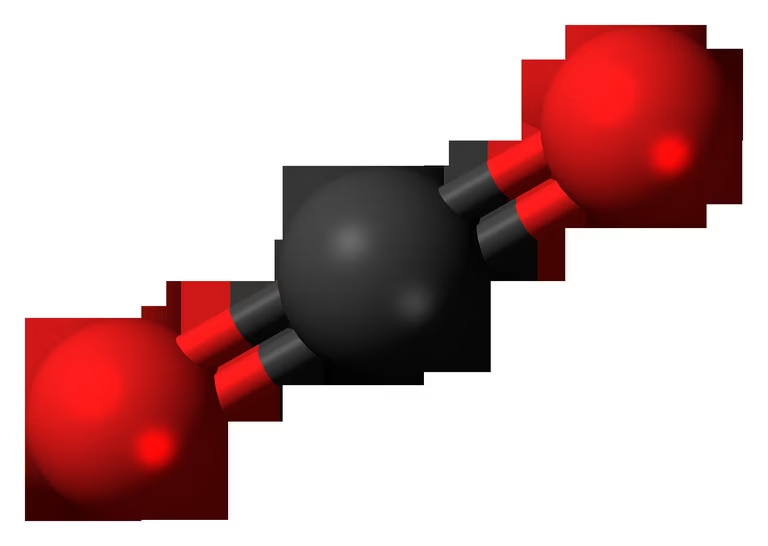
Oxygen is a chemical element with the symbol O and atomic number 8. In ordinary air and in most practical situations, oxygen is present as the O₂ molecule, a colorless, odorless gas at normal temperatures and pressures. That distinction matters for basic questions such as what is oxygen, what is O₂, is oxygen an element, and is oxygen a gas. Oxygen is both: oxygen is the element, and O₂ is the common diatomic gas form of that element. Oxygen is the most abundant element in Earth's crust, and after hydrogen and helium it is the third-most abundant element in the universe.
Identity
An oxygen atom is a single atom of the oxygen element. An O₂ molecule contains two oxygen atoms bonded together. The oxygen in air that supports respiration is this O₂ molecule.
Oxygen is a nonmetal in Group 16 of the periodic table. At about 21% by volume, oxygen in the atmosphere is a major component of air. By mass, oxygen accounts for more than 46% of Earth's crust. Oxygen also occurs extensively in water, minerals, and biological molecules rather than only as oxygen gas.
A short practical answer to "what is oxygen made of" is that elemental oxygen is made of oxygen atoms. In the atmosphere, those atoms are usually paired as O₂. Oxygen also has another important allotrope, ozone, O₃, which is formed from oxygen and used in oxidation and disinfection processes.
Properties
Oxygen properties explain why oxygen is useful in both biology and industry. Oxygen gas is colorless, odorless, and tasteless. Liquid oxygen is pale blue and is formed below -183.0 °C. Solid oxygen forms near -218.4 °C. Oxygen is slightly heavier than air.
Oxygen supports combustion but is not itself flammable. That point is central to oxygen safety. Materials burn because oxygen acts as an oxidizer. As oxygen concentration or oxygen pressure rises, ignition becomes easier, flame temperatures rise, and burning can become much more intense. In oxygen-enriched conditions, materials that burn slowly in air can burn rapidly, and some materials not usually considered combustible can ignite more readily.
In water, dissolved oxygen is essential for fish and other aquatic life. Oxygen is also chemically active and forms compounds with most elements. That is why oxygen is so common in minerals, water, acids, salts, and organic compounds.
Earth systems
Where does oxygen come from on Earth? Most free oxygen in the atmosphere is generated by photosynthesis. Green plants, algae, and photosynthetic microorganisms use sunlight to convert carbon dioxide and water into organic matter and release oxygen. Marine plankton contribute a large share of global oxygen production, and ocean photosynthesis accounts for roughly half of present oxygen production.
Oxygen cycle processes move oxygen through the atmosphere, hydrosphere, biosphere, and lithosphere. Oxygen in the atmosphere is consumed by respiration, decomposition, combustion, and oxidation reactions, then replenished mainly by photosynthesis. Oxygen is also dissolved in water and locked into minerals such as silicates, carbonates, sulfates, and oxides. In practical terms, most of Earth's oxygen is not in the air. It is bound in rocks, water, and other compounds.
Role in life
The role of oxygen in respiration is straightforward. Animals, many microorganisms, and human tissues use oxygen to support cellular energy production. In air breathing, oxygen in air is taken into the lungs and transferred to the blood. In aquatic environments, organisms depend on dissolved oxygen in water.
For this reason, oxygen is not only an industrial gas. Oxygen is part of the basic conditions that sustain aerobic life.
Uses
What is oxygen used for? The uses of oxygen span medicine, industry, water treatment, laboratories, and transport systems. Some oxygen uses depend on oxygen as a breathing gas, while others depend on oxygen as an oxidizer.
Medicine
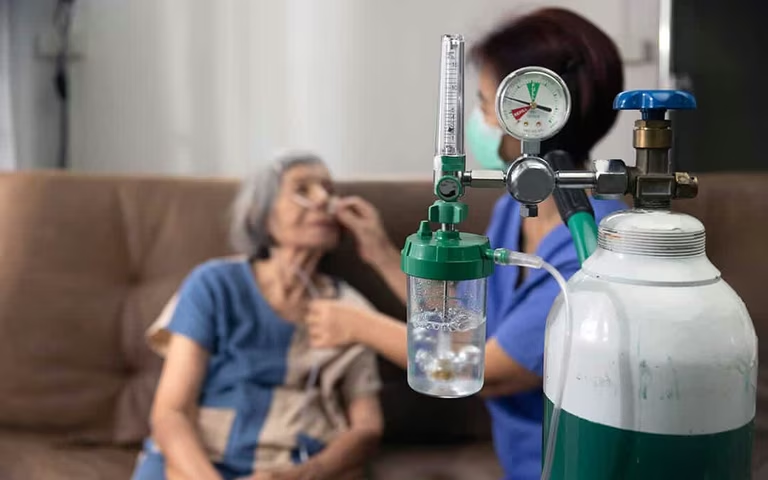
Medical oxygen is an essential medicine. Oxygen is used to treat respiratory illnesses such as COVID-19 and pneumonia. Oxygen is also essential in surgery, trauma care, anesthesia support, resuscitation, and critical care. Older adults, pregnant women, newborns, and young infants often require oxygen therapy as part of routine medical support.
In hospitals and home care, oxygen may be delivered from cylinders, liquid oxygen systems, central piping, or oxygen concentrators. Pulse oximetry is commonly used to assess whether oxygen therapy is needed and how much support is required.
Respiration support
Supplemental oxygen is used when a patient cannot maintain adequate oxygenation from room air alone. Ordinary clinical oxygen therapy is very different from extreme oxygen exposure. Medical oxygen delivery by mask is typically about 30-50% O₂ by volume, which is around 30 kPa at standard pressure. That is below the range where oxygen toxicity usually becomes the main concern.
Water treatment
Pure oxygen is used in ozone production. Ozone is widely used for oxidation, odor control, disinfection, and water purification. In wastewater treatment, ozone can inactivate pathogens and oxidize organic contaminants. Oxygen itself is also used to raise dissolved oxygen in treatment processes, supporting aerobic biological treatment.
In aquatic systems, added oxygen can improve dissolved oxygen levels. Oxygen and ozone have both been used in aquaculture water treatment. Oxygenation supports fish respiration, while ozone can reduce color, odors, some dissolved contaminants, and microbial loads when properly controlled.
Metal production
The steel industry is the largest user of oxygen. Oxygen is used to increase combustion temperature and improve process efficiency in steelmaking and other metallurgical operations.
Oxygen also significantly increases gold processing and ore flow, helping reduce cyanide consumption and waste products. Industrial oxygen generators are used in the production of other metals such as copper and lead. In mining operations, a continuous supply of large amounts of oxygen can be important for both process performance and safety, and on-site oxygen generation can provide that supply efficiently.
Welding and cutting
Industrial oxygen is widely used in oxy-fuel welding and cutting. Oxygen increases flame temperature and makes metal cutting more effective. This is one of the most familiar oxygen uses outside medicine.
Chemical manufacturing
Oxygen is used in oxidation-controlled chemical processes and in the production of a wide range of industrial chemicals. It is also used where high-purity oxidizing conditions are needed in process plants and laboratories.
Aerospace and closed environments
Liquid oxygen is used as an oxidizer in rocket propulsion. Oxygen is also part of breathing gas systems for spacecraft, submarines, diving operations, and other enclosed environments where breathable air must be supplied or controlled.
Production
Industrial oxygen production is usually based on separating oxygen from air. The main large-scale method is cryogenic air separation. In that process, air is compressed, cleaned, cooled until liquefied, and then separated by fractional distillation because nitrogen, argon, and oxygen have different boiling points. Oxygen boils at about -183 °C, argon at about -186 °C, and nitrogen at about -196 °C.
For smaller-scale oxygen production, oxygen can also be generated from air using adsorption systems. Oxygen concentrators and pressure- or vacuum-swing adsorption units remove much of the nitrogen from air and leave an oxygen-enriched product stream. These systems are common in medical oxygen supply and some industrial oxygen applications.
Storage and delivery
Oxygen is commonly stored and delivered in three forms:
| Form | Typical use | Main features |
|---|---|---|
| Compressed oxygen gas | Cylinders, pipelines | Portable and widely used; high-pressure gas |
| Oxygen concentrator output | Medical and on-site generation | Produced from air at point of use |
| Liquid oxygen | Bulk storage, hospitals, aerospace | Cryogenic storage with high volumetric efficiency |
Liquid oxygen, often called LOX, is stored at cryogenic temperature. When warmed, it expands greatly as it vaporizes. One liter of liquid oxygen yields about 860 liters of gaseous oxygen. That high expansion ratio is why liquid oxygen is useful for large supply systems, but it also explains its pressure and venting hazards.
Safety
Oxygen safety starts with one basic fact: oxygen is nonflammable, but it is a strong oxidizer. That means oxygen does not burn as a fuel, yet it can make other materials ignite more easily and burn much more vigorously.
NFPA
Under the NFPA 704 system, compressed oxygen gas is rated as nonhazardous to health, nonflammable, and nonreactive, with an oxidizer designation. Refrigerated liquid oxygen has a health hazard rating of 3 because of the increased risk from condensed vapors and cryogenic contact, while the flammability and reactivity ratings remain the same as for compressed oxygen gas.
Fire risk
In oxygen-enriched atmospheres, ignition energy is lower and combustion becomes more intense. Oils, grease, fuels, many plastics, textiles, paper, wood, and contaminated surfaces can become severe fire hazards around oxygen. Clothing exposed to oxygen can also ignite more easily. For this reason, oxygen systems must be kept free of oil and grease, and oxygen equipment must be designed for oxygen service.
Because oxygen enrichment often cannot be detected by human senses, ventilation and leak control matter. Oxygen can accumulate in low-lying areas, especially after a liquid oxygen spill.
Compressed gas and cryogenic hazards
Compressed oxygen cylinders present the usual hazards of stored high-pressure gas. Cylinders must be secured, handled carefully, and protected from heat and physical damage.
Liquid oxygen adds cryogenic hazards. Contact with liquid oxygen or cold LOX surfaces can cause severe frostbite or cryogenic burns. Spills can create dense oxygen-enriched clouds and can enrich nearby combustible materials.
Toxicity
Oxygen toxicity is caused by elevated oxygen partial pressure rather than by oxygen at its normal concentration in air. Oxygen gas can become toxic at high partial pressures, leading to convulsions and other serious effects.
Oxygen toxicity usually begins to occur when oxygen partial pressure exceeds about 50 kPa. That is roughly equivalent to breathing about 50% oxygen at standard pressure, or about 2.5 times the normal sea-level oxygen partial pressure of about 21 kPa.
Practical context
This is mainly a risk in specialized settings. Important examples include:
- prolonged exposure to high oxygen concentrations in critical care
- hyperbaric oxygen environments
- diving with oxygen-enriched breathing gases
- high-pressure work in compressed environments
At much higher oxygen partial pressures, central nervous system effects such as visual changes, nausea, muscle twitching, and seizures can occur. Pulmonary effects can develop with prolonged exposure to high oxygen concentrations.
Ordinary oxygen therapy is a different case. Gas supplied through oxygen masks in routine medical applications is typically only 30-50% O₂ by volume, about 30 kPa at standard pressure. For that reason, oxygen toxicity is generally not a major issue in standard short-term clinical oxygen use. The more significant concern is in prolonged, high-concentration, or high-pressure exposure, especially in mechanically ventilated patients or hyperbaric conditions.
References
World Health Organization. Oxygen. URL
The Editors of Encyclopaedia Britannica. Oxygen. URL
The Editors of Encyclopaedia Britannica. Oxygen cycle. URL
National Oceanic and Atmospheric Administration. How much oxygen comes from the ocean? URL
Royal Society of Chemistry. Oxygen - Element information, properties and uses. URL
Air Liquide. Air Separation Unit (ASU): How Air Liquide produces gases essential to industry and healthcare. URL
World Health Organization. Clinical care for severe acute respiratory infection: toolkit. COVID-19 adaptation. Geneva: World Health Organization; 2020. URL
European Industrial Gases Association. Fire hazards of oxygen and oxygen-enriched atmospheres. Doc 04/18. URL
Merck Manual Professional Edition. Gas Toxicity During Diving. URL
United States Environmental Protection Agency. Wastewater Technology Fact Sheet: Ozone Disinfection. 1999. URL
United States Environmental Protection Agency. Dissolved Oxygen. URL