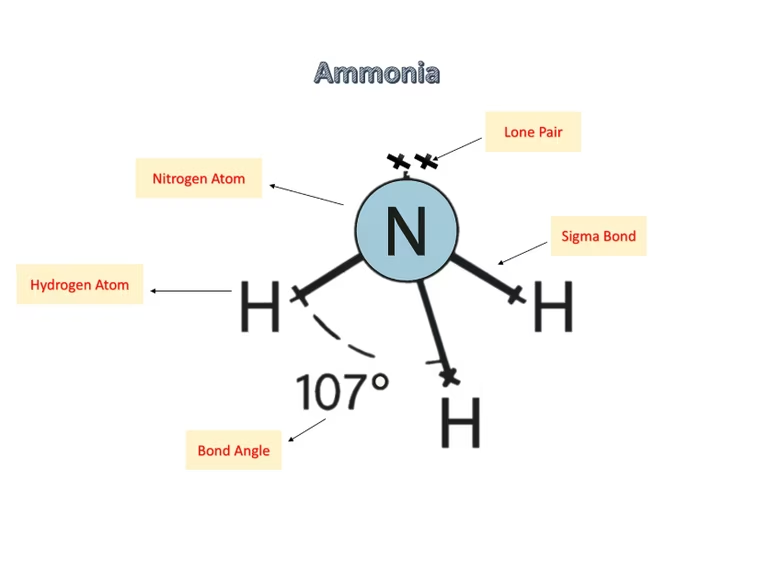
The NH₃ Lewis structure has nitrogen at the center, three single N-H bonds, and one lone pair on nitrogen. This ammonia Lewis structure uses 8 total valence electrons, gives hydrogen a duet, gives nitrogen an octet, and places a formal charge of 0 on every atom.
Final structure
For the lewis structure for NH3, the finished drawing is simple once the rules are clear:
- one central nitrogen atom
- three surrounding hydrogen atoms
- three single N-H bonds
- one lone pair on nitrogen
That is the complete electron dot structure of NH3. No double bonds are present, and hydrogen is never the central atom.
This structure is correct because nitrogen normally forms three bonds and keeps one lone pair in a neutral molecule. Hydrogen forms only one bond and follows the duet rule, so each hydrogen can have only 2 electrons around it.
Valence electrons
The first step in drawing the nh3 lewis structure is counting valence electrons.
Nitrogen is in group 15, so nitrogen contributes 5 valence electrons. Each hydrogen contributes 1 valence electron. With three hydrogens, that adds 3 more electrons.
NH₃ total valence electrons = 5 + 3 = 8
This is the answer to the common question "how many valence electrons does NH3 have?" The dot structure of ammonia must account for all 8 of these electrons.
Central atom
In the lewis structure of ammonia, nitrogen is the central atom. Hydrogen stays on the outside.
A common rule says the less electronegative atom often goes in the center, but hydrogen is the main exception. Hydrogen cannot be the central atom because hydrogen can form only one single bond. If hydrogen were placed in the center, the rest of the structure could not be completed correctly.
So for the NH₃ molecule, nitrogen must be in the middle and the three hydrogen atoms must be terminal atoms.
Drawing steps
Step 1
Count all valence electrons.
- N = 5
- 3H = 3
- total = 8 electrons
Step 2
Place nitrogen in the center and place the three hydrogen atoms around it.
Step 3
Connect each hydrogen to nitrogen with a single bond.
Each single bond contains 2 electrons. Three N-H single bonds use 6 electrons total. That leaves 2 electrons still to place.
Step 4
Put the remaining 2 electrons on nitrogen as one lone pair.
At this point, each hydrogen has 2 electrons through its single bond. Nitrogen has 6 electrons from the three bonds plus 2 electrons in the lone pair, so nitrogen has 8 electrons around it.
The lewis structure for nh3 is now complete.
Why it works
The structure of ammonia follows two basic ideas: the duet rule for hydrogen and the octet rule for nitrogen.
Hydrogen is stable with 2 electrons, not 8. That is why hydrogen forms one bond and stops. Nitrogen is a second-period element, so it generally follows the octet rule and is most stable with 8 electrons in its valence shell.
In the ammonia lewis structure, nitrogen reaches an octet by sharing three pairs of electrons with hydrogen and retaining one lone pair. Each hydrogen reaches a duet through one N-H bond.
This is also why the electron dot structure of NH3 does not contain extra bonds. A double bond to hydrogen is not allowed in normal Lewis structures because hydrogen cannot have more than one bond.
Formal charge
The nh3 lewis structure formal charge check confirms that the usual drawing is the best one.
Formal charge is calculated as:
Formal charge = valence electrons - unbonded electrons - 1/2(bonding electrons)
For nitrogen in NH₃:
- valence electrons = 5
- unbonded electrons = 2
- bonding electrons = 6
Formal charge on N = 5 - 2 - 6/2 = 0
For each hydrogen atom:
- valence electrons = 1
- unbonded electrons = 0
- bonding electrons = 2
Formal charge on H = 1 - 0 - 2/2 = 0
So the formal charge of NH3 is zero on nitrogen and zero on each hydrogen. The molecule is neutral overall.
This point often causes confusion. NH₃ has no overall charge. Its best Lewis structure also gives zero formal charge on all atoms. That is different from related species such as NH₄⁺, where nitrogen has four N-H bonds and a positive overall charge, or NH₂⁻, which carries a negative overall charge.
Geometry
After drawing the nh3 lewis dot structure, the next question is usually shape.
Ammonia has four electron regions around nitrogen:
- three bonding pairs
- one lone pair
That gives a tetrahedral electron-group arrangement. But the molecular geometry of NH3 is trigonal pyramidal, not tetrahedral and not trigonal planar.
The reason is that molecular geometry describes the positions of atoms, while electron geometry includes lone pairs as well. In ammonia, the lone pair occupies one of the four electron regions, so the three hydrogen atoms form a trigonal pyramidal arrangement.
Bond angle
The bond angle of ammonia is about 107°. A perfect tetrahedral angle is 109.5°, but ammonia is slightly smaller because the lone pair on nitrogen repels bonding pairs more strongly than bonding pairs repel one another.
As a result, the H-N-H angles are compressed from the ideal tetrahedral value. This is why ammonia is trigonal pyramidal rather than flat.
Polarity
Ammonia is a polar molecule.
Each N-H bond is polar because nitrogen is more electronegative than hydrogen. The NH₃ structure is also asymmetric because of the lone pair on nitrogen and the trigonal pyramidal shape. The bond dipoles do not cancel.
So the ammonia molecule has a net dipole moment. The polarity of ammonia is tied directly to the same lone pair that appears in the lewis structure of nh3.
Lewis structure vs other representations
The structure of ammonia can be described in several ways, and these terms are not identical.
- Lewis structure of NH₃: shows valence electrons, bonds, and the lone pair
- structural formula: usually shows only the atom connections
- molecular geometry: describes the 3D shape, which is trigonal pyramidal
- electron geometry: describes electron-group arrangement, which is tetrahedral
- electron dot structure of NH3 or NH3 lewis dot structure: another name for the Lewis representation
Students often mix these together. The lewis structure of ammonia is the electron-accounting model. The molecular geometry of NH3 is the three-dimensional shape that results from that electron arrangement.
Common mistakes
Several errors show up repeatedly when drawing the ammonia lewis structure.
Hydrogen in the center
This is incorrect. Hydrogen can form only one bond, so hydrogen cannot be the central atom.
Multiple bonds to hydrogen
This is also incorrect. Hydrogen cannot make double or triple bonds in a normal Lewis structure.
Wrong valence electron count
NH₃ has 8 total valence electrons, not 6 and not 10. Miscounting here causes the rest of the structure to fail.
Missing lone pair
Nitrogen must have one lone pair in neutral ammonia. If the lone pair is omitted, nitrogen has only 6 electrons around it and the drawing is incomplete.
Calling NH₃ trigonal planar
NH₃ is not trigonal planar. The lone pair changes the molecular shape to trigonal pyramidal.
Chemical meaning
The lone pair on nitrogen is not just a drawing detail. It explains much of ammonia's chemical behavior.
Ammonia acts as a Lewis base because nitrogen has a lone pair available for donation. Ammonia also acts as a Brønsted-Lowry base by accepting a proton to form NH₄⁺. In water, ammonia can accept a proton from water to produce NH₄⁺ and OH⁻.
That same lone pair also contributes to the polarity of ammonia and to its trigonal pyramidal shape. So the NH₃ Lewis structure is directly connected to the real behavior of the molecule, not only to a homework procedure.