Silicon dioxide is a silicon-oxygen compound found widely in nature and also produced for food use. What is silicon dioxide in foods and supplements? In ordinary label terms, it is usually a food additive used in very small amounts to keep powders free-flowing and stable. For the question "is silicon dioxide bad for you" or "is silicon dioxide safe," the short answer is that food grade silicon dioxide is generally considered safe at permitted use levels, but that answer depends on form, dose, and route of exposure. The main concern linked to silica is usually not silicon dioxide in food. It is crystalline silica dust inhaled over time in workplaces.
Identity
Silicon dioxide occurs naturally in water, plants, animals, and the earth. Silica accounts for about 59% of the earth's crust and is the main constituent of more than 95% of known rocks. Silicon is also present in human tissues, although the biological role of silicon in humans remains unsettled.
That last point needs care. Dietary silicon and added silicon dioxide are not the same claim. Silicon has been studied as a possible nutrient, but that does not mean silicon dioxide is added to food for nutritional benefit.
Food forms
In food, silicon dioxide is typically used as synthetic amorphous silica. This matters. Food additive silicon dioxide is different from crystalline silica, the form associated with occupational lung disease after long-term inhalation.
Synthetic amorphous silica used as E551 or INS 551 is produced in several forms:
- fumed or pyrogenic silica
- precipitated silica
- silica gel
- hydrous silica
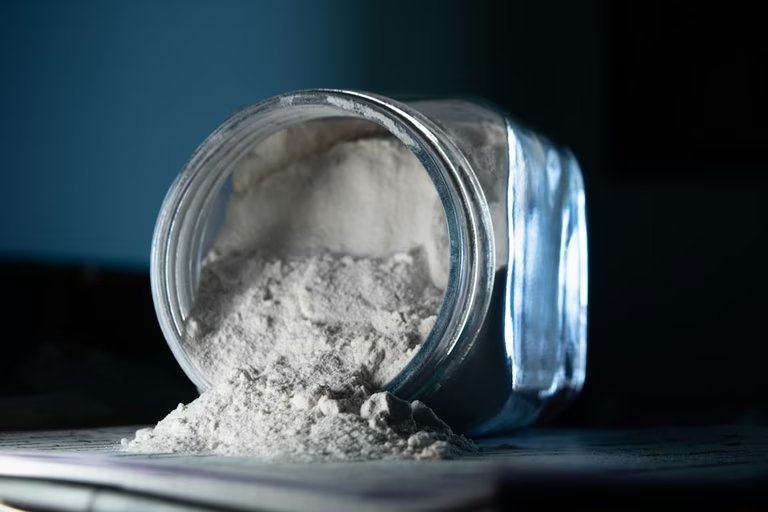
These materials are amorphous rather than crystalline. They are generally white powders or granules, hygroscopic, and used for physical processing functions rather than taste or nutrition.
Why it is used
Silicon dioxide uses in food are practical. Manufacturers add it because powders and dry blends are difficult to handle when they absorb moisture, clump, foam, or separate.
According to the functions described for food and supplement use, silicon dioxide can:
- act as an anti-caking agent
- help prevent corrosion
- work as a defoaming aid
- reduce moisture uptake by powders
- help stabilize and clarify beer
- help carry and distribute flavoring oils
- adsorb alcohol
- assist in processing wine and gelatin
On labels, silicon dioxide in food is often found in powdered seasonings, drink mixes, spices, coffee creamers, tableted supplements, and other dry processed products. In these products, anti-caking is the main reason. A free-flowing powder fills, blends, and doses more consistently during manufacturing and stays usable during storage.
In the United States, silicon dioxide is permitted for use as an anticaking agent in food and may not exceed 2% by weight of the food. It is also permitted as a stabilizer in beer production, with removal before final processing, and as an adsorbent for certain ingredients in special dietary foods.
Safety
For normal dietary exposure, the answer to "is silicon dioxide harmful to humans" is usually no. Food grade silicon dioxide has been evaluated by major regulators and is permitted for specific uses.
In the U.S., FDA regulations allow silicon dioxide to be safely used under defined conditions in food. In Europe, EFSA's recent re-evaluation of E551 concluded that silicon dioxide does not raise a safety concern at reported uses and use levels for the general population, including infants under 16 weeks at current exposure levels. EFSA did not set an acceptable daily intake, not because ordinary use was found unsafe, but because the evidence base was handled through a margin-of-exposure approach that included nano-specific considerations. EFSA concluded that the calculated margins of exposure were above the level considered necessary not to raise a safety concern.
That is the practical safety verdict. Food grade silicon dioxide is generally considered safe in the amounts used in foods and supplements.
Nanoparticles
The nanoparticle issue is the main reason this ingredient still draws questions. Not all food grade silicon dioxide is made only of large particles. Synthetic amorphous silica can include nano-sized constituent particles that form larger aggregates and agglomerates.
A nanoparticle is usually discussed as a particle with at least one dimension in the 1-100 nm range. For food additive E551, EFSA described synthetic amorphous silica as near-spherical nano-sized constituent particles, commonly with median sizes in the low nanometer range, that form larger fractal-like aggregates. FDA analytical work also found that commercial food grade silicon dioxide can contain nanosized primary particles together with larger aggregates and agglomerates.
This does not mean that all silicon dioxide in food behaves as isolated nanoparticles in the body. In food systems and in the digestive tract, these materials often occur as aggregates or larger clumps. Available digestion studies indicate low dissolution in simulated gastric and intestinal conditions, and much of the material remains as undissolved particles or aggregates during digestion.
Human concern remains focused on whether long-term ingestion of nano-sized forms could affect the gut barrier, immune signaling, DNA integrity, or cells. Those questions are still being studied. Current evidence has not established harmful effects in humans at typical dietary exposure, but regulators have treated the nano aspect as a real technical issue rather than ignoring it.
Absorption
Food grade silicon dioxide appears to have very low oral absorption. Animal toxicokinetic work reviewed by EFSA found that systemic availability is expected to be very low and generally below 0.2%, with the relative absorbed fraction tending to decrease as dose increases.
After uptake into cells, silicon dioxide can be converted to silicic acid, Si(OH)₄. Silicic acid and ionic silicon are then excreted mainly through the kidneys. Most ingested material is eliminated in feces.
This low absorption helps explain why safety assessments for oral exposure differ sharply from inhalation hazards.
Side effects
What about silicon dioxide side effects from normal eating or supplement use? Evidence for clear, routine side effects from food-level exposure is limited.
Some people search for silicon dioxide allergy or silicon dioxide allergy symptoms. A true allergy to silicon dioxide itself appears uncommon. When symptoms occur after taking a supplement or processed food, another ingredient is often a more plausible cause, such as flavorings, binders, botanicals, sweeteners, or the active supplement ingredient.
Digestive complaints are sometimes mentioned online, but established evidence linking normal dietary silicon dioxide intake to consistent gastrointestinal side effects in humans is weak. Experimental literature has explored intestinal inflammation, barrier effects, and immune changes, yet the findings are not sufficient to treat ordinary intake as a known cause of common GI symptoms.
There is one unusual human case report involving urinary gravel and silicate stones in a woman taking supplements that provided silica exposure. Symptoms resolved after stopping the supplements and returned after restarting them. That case does not show that normal food additive exposure commonly causes kidney stones, but it does show that high or unusual supplemental exposure is not identical to trace additive use in food.
Crystalline silica
The largest real-world hazard linked to silica is crystalline silica dust inhalation. This is separate from silicon dioxide in food.
Crystalline silica is found in materials such as sand, stone, concrete, brick, mortar, and some other minerals. When these materials are cut, drilled, crushed, ground, or blasted, respirable crystalline silica can be released. Long-term inhalation can cause silicosis, lung cancer, chronic obstructive pulmonary disease, and kidney disease.
Occupational risk is most relevant in industries such as:
- mining
- construction
- steel and foundry work
- sandblasting
These are the situations where silica side effects are serious and well established. The route of exposure is inhalation, not eating.
When to care
For most people reading an ingredient label, silicon dioxide in food is not a high-priority safety concern.
More attention is reasonable in a few situations. Occupational exposure matters if work involves dust from stone, concrete, sand, or similar materials. Heavy supplement use deserves more scrutiny than occasional use, especially if many products are taken daily. People trying to reduce additive intake can choose less processed foods, but that is a broader dietary preference rather than a special warning specific to food grade silicon dioxide.
A practical way to think about it is simple:
| Situation | Main concern |
|---|---|
| Spice blend, drink mix, tablet supplement | Low-level food additive exposure |
| Long-term work with cutting, grinding, blasting, mining | Inhaled crystalline silica dust |
| Taking many supplements daily | Cumulative exposure from multiple products |
| Wanting fewer additives overall | Choose less processed foods |
The key distinction is still form and exposure route. Food grade silicon dioxide is usually amorphous silica used in small amounts for processing. Crystalline silica is the inhalation hazard associated with industrial dust.
References
U.S. Food and Drug Administration. Analysis of Silicon Dioxide Food Additives. URL
21 CFR § 172.480 - Silicon dioxide. URL
EFSA Panel on Food Additives and Flavourings (FAF). Re-evaluation of silicon dioxide (E 551) as a food additive in foods for infants below 16 weeks of age and follow-up of its re-evaluation as a food additive for uses in foods for all population groups. EFSA Journal. 2024;22(10):e8880. URL
Occupational Safety and Health Administration. Silica, Crystalline - Overview. URL
Occupational Safety and Health Administration. OSHA’s Respirable Crystalline Silica Standard for Construction. URL
Encyclopaedia Britannica. Silica. URL
Rondanelli M, Faliva MA, Peroni G, Gasparri C, Perna S, Riva A, Petrangolini G, Tartara A. Silicon: A neglected micronutrient essential for bone health. Experimental Biology and Medicine. 2021;246(13):1500-1511. URL