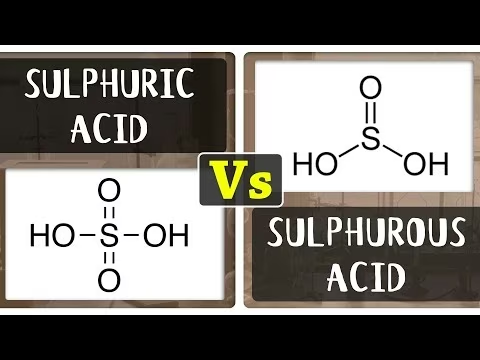
Sulfuric acid and sulfurous acid are sulfur oxyacids with similar names but very different chemistry. Sulfuric acid has the formula H₂SO₄. Sulfurous acid has the formula H₂SO₃. The difference between sulfuric acid and sulfurous acid starts with one extra oxygen atom, but that small structural change affects acid strength, oxidation state, stability, and practical use.
Comparison
A side-by-side view makes the distinction clearer.
| Property | Sulfuric acid | Sulfurous acid |
|---|---|---|
| Formula | H₂SO₄ | H₂SO₃ |
| Sulfur oxidation state | +6 | +4 |
| Acid strength | Strong acid overall; first dissociation is essentially complete in water, second is weaker | Weak acid |
| Usual structure | Sulfur bonded to four oxygens in a tetrahedral arrangement | Sulfur bonded to three oxygens with a trigonal pyramidal arrangement |
| Physical status in practice | Common bulk industrial liquid | Better understood as sulfur dioxide in water and related equilibria |
| Common related ions | HSO₄⁻, SO₄²⁻ | HSO₃⁻, SO₃²⁻ |
| Typical occurrence | Major commodity chemical | Mostly encountered through dissolved SO₂, bisulfite, and sulfite chemistry |
Sulfuric acid is what is usually meant by H₂SO₄ chemical name, battery acid, or a strong mineral acid used at industrial scale. Sulfurous acid is much less often handled as an isolated substance even though the sulfurous acid formula, H₂SO₃, appears in textbooks and reaction schemes.
Structures
In sulfuric acid, sulfur is in the +6 oxidation state and is surrounded by four oxygen atoms. The basic molecular geometry is tetrahedral. In simple terms, the sulfur atom sits at the center and the oxygen atoms point toward four corners around it.
For sulfurous acid, sulfur is in the +4 oxidation state. H₂SO₃ has one fewer oxygen, and the sulfur center is described as trigonal pyramidal. That means the three oxygen atoms define the base of the arrangement and sulfur is not as symmetrically surrounded as it is in sulfuric acid.
This is also where the naming pattern comes from. For sulfur oxyacids, the form with the higher oxidation state takes the "-ic" ending and the lower oxidation state takes the "-ous" ending. Therefore, H₂SO₄ is sulfuric acid and H₂SO₃ is sulfurous acid.
Acid strength
For anyone asking "is H₂SO₄ a strong acid," the short answer is yes. Sulfuric acid is classified as a strong acid because its first proton is released essentially completely in water. The second proton is not released as completely, so the second dissociation is weaker, but sulfuric acid still behaves as a very strong mineral acid in ordinary aqueous chemistry.
Sulfurous acid is H₂SO₃ strong or weak? It is weak. Sulfurous acid ionizes only partially in water, and its equilibria depend strongly on solution conditions.
The main reason sulfuric acid is stronger than sulfurous acid is not sulfur electronegativity, since both acids contain the same central atom. The more useful model is oxygen count and conjugate base stabilization. Sulfuric acid has an extra oxygen atom. That extra oxygen withdraws electron density more strongly from the O-H bonds and helps spread negative charge over the conjugate base after proton loss. A more stabilized conjugate base means stronger acidity.
In other words, sulfuric acid is stronger because HSO₄⁻ and SO₄²⁻ are better stabilized than the corresponding sulfurous acid conjugate bases. This is a standard oxyacid strength pattern: when the central atom is the same, the acid with more oxygens is usually stronger.
Dissociation
Sulfuric acid dissociates in two steps:
H₂SO₄ → H⁺ + HSO₄⁻
HSO₄⁻ ⇌ H⁺ + SO₄²⁻
That first step is the one treated as essentially complete in water. The second step is appreciable but not complete.
Sulfurous acid also dissociates stepwise:
H₂SO₃ ⇌ H⁺ + HSO₃⁻
HSO₃⁻ ⇌ H⁺ + SO₃²⁻
Both steps are equilibrium processes characteristic of a weak acid. This is why asking only whether sulfurous acid is strong or weak gives the right practical answer, but the fuller picture is that H₂SO₃ exists in acid-base equilibrium with bisulfite and sulfite.
Why sulfurous acid is unusual
Sulfurous acid is not usually encountered as a stable, isolable bottled acid in the same way as sulfuric acid. That point is one of the most important differences between sulfuric acid and sulfurous acid.
Sulfurous acid is better described as sulfur dioxide dissolved in water, together with equilibria involving HSO₃⁻ and SO₃²⁻. Sulfur dioxide dissolves readily in water and forms a weakly acidic solution. In solution chemistry, the system is commonly represented by H₂SO₃, but sulfurous acid itself has long been regarded as elusive in the condensed phase. The molecule has been detected in the gas phase, which supports its chemical reality, but ordinary aqueous "sulfurous acid" is usually a dissolved SO₂/bisulfite/sulfite system rather than a stable pure acid phase.
A representative preparation of bisulfite salts is treatment of alkali with excess sulfur dioxide:
SO₂ + NaOH → NaHSO₃
That reaction helps explain why sulfurous acid chemistry is often discussed through bisulfite rather than through isolated H₂SO₃.
Uses
Sulfuric acid is a major commodity chemical and is produced on very large scale. It is widely used to make phosphoric acid and fertilizers, especially phosphate fertilizers. Sulfuric acid is also used in petroleum refining, in iron and steel production, in metal cleaning and pickling, and as the electrolyte in lead-acid batteries. Because concentrated sulfuric acid is strongly dehydrating, it is also used in chemical processing where water removal is useful. In the lab and plant, sulfuric acid can act as an oxidizing, dehydrating, or sulfonating reagent depending on concentration and conditions.
The original article also noted that sulfuric acid is among the chemicals released by the paper industry by weight, and sulfuric acid remains relevant across pulp and paper operations and related industrial emissions discussions.
Sulfurous acid is encountered much less as a standalone reagent. Its chemistry appears mainly where sulfur dioxide is dissolved in water or where bisulfite and sulfite salts are used. That includes reducing and bleaching systems, sulfite and bisulfite preservatives, and some paper and pulp processes based on sulfite chemistry. Sulfur dioxide and sulfite species are also used in food preservation and bleaching applications, although these practical systems are usually framed in terms of SO₂, bisulfite, or sulfite rather than pure sulfurous acid.
Reactivity
Concentrated sulfuric acid is highly corrosive and reacts with many substances. It dissolves many metals, especially in dilute form, and can char many organic materials because it removes water from them. Wood, paper, sugars, and many other organic substances are strongly affected. Sulfuric acid is also miscible with water with a large release of heat.
That combination of strong acidity and dehydration explains why sulfuric acid is treated with unusual caution in industry. Its chemistry is not limited to proton donation.
Sulfurous acid-related solutions are weaker, but they are still chemically active. Aqueous sulfur dioxide and bisulfite systems can act as reducing agents and are readily oxidized to sulfate or sulfuric acid-related end products.
Misconceptions
One common point of confusion is the name similarity. Sulfuric acid is not sulfurous acid. H₂SO₄ is not H₂SO₃. The sulfur oxidation state in H₂SO₄ is +6, while the sulfur oxidation state in H₂SO₃ is +4.
Another common confusion is between sulfurous acid and sulfur dioxide solution. In practice, many references to sulfurous acid describe an SO₂-in-water system.
A third confusion involves hydrosulfuric acid. Hydrosulfuric acid is H₂S, not H₂SO₃. It is not a sulfur oxyacid and should not be grouped with sulfuric acid and sulfurous acid just because the names sound similar.
Safety
Sulfuric acid is highly corrosive to skin, eyes, metals, and many materials. Concentrated sulfuric acid is also strongly dehydrating, which adds thermal and chemical damage during contact. Mixing sulfuric acid with water releases substantial heat, and industrial hygiene guidance treats sulfuric acid mist as a respiratory hazard. In occupational settings, sulfuric acid mists are the form linked to the strongest long-term respiratory concern.
Sulfurous acid-related solutions are weaker than sulfuric acid, but they are not harmless. Sulfur dioxide-containing solutions and sulfurous acid preparations can irritate tissue, corrode metals, and release sulfur dioxide odor and vapor. Their practical hazard profile often reflects both acidity and sulfur dioxide exposure.
The comparison therefore stops well before "strong" and "weak" become simple labels. Sulfuric acid is an industrial corrosive and dehydrating acid of very high consequence. Sulfurous acid is a weaker, more unstable aqueous sulfur(IV) system that is usually handled through sulfur dioxide, bisulfite, and sulfite chemistry.
References
PubChem. Sulfuric Acid. URL
PubChem. Sulfurous Acid. URL
PubChem. Sulfur Dioxide. URL
PubChem. Sodium Bisulfite. URL
Encyclopaedia Britannica. Sulfuric acid. URL
Centers for Disease Control and Prevention, National Institute for Occupational Safety and Health. Sulfuric Acid. URL
IARC Working Group on the Evaluation of Carcinogenic Risks to Humans. Sulfur Dioxide and Some Sulfites, Bisulfites and Metabisulfites. Occupational Exposures to Mists and Vapours from Strong Inorganic Acids; and Other Industrial Chemicals. Lyon: International Agency for Research on Cancer; 1992. URL
IARC Working Group on the Evaluation of Carcinogenic Risks to Humans. Occupational Exposures to Mists and Vapours from Sulfuric Acid and Other Strong Inorganic Acids. Occupational Exposures to Mists and Vapours from Strong Inorganic Acids; and Other Industrial Chemicals. Lyon: International Agency for Research on Cancer; 1992. URL